Ending Explained
Fight Club Ending Explained: Did Tyler Win? (2026)

Fight Club ending explained: The Narrator shoots himself through the cheek to destroy Tyler Durden, the second personality he built out of his own insomnia. Tyler's body drops. The Narrator survives. Project Mayhem's charges still fire, and the credit-card towers come down while he stands at the window holding Marla Singer's hand. His last line is "You met me at a very strange time in my life." The film ends there, and never confirms that Tyler is gone.
That is the whole ending, and almost nobody finds it confusing. The confusion sits one layer down. Fight Club is one of the few famous twist films where the reveal is stated plainly, twice, and the audience still argues about what it means. The Narrator is Tyler. Tyler is the Narrator. The film says so out loud, then spends its final four minutes refusing to tell you whether killing Tyler accomplished anything.
What makes this ending unusual is that both men who could have settled it have answered, and their answers contradict each other. Chuck Palahniuk wrote the novel, and he thinks the version where Tyler loses is the truer one. David Fincher directed the film, and he thinks the version where the towers fall is the only one worth licensing. When the two authors of the same story disagree about its ending, the ambiguity is not a puzzle the viewer failed to solve. It is the actual content. This article works through what happens on screen, the frame most people miss, the four frames hidden before the twist, and what the two endings that were almost used instead tell us about the one we got.
Key Findings at a Glance
- Fight Club earned $37 million in the United States and Canada against a budget of $63 million. Worldwide it reached $100.9 million, which the studio treated as a failure.
- The opening weekend took $11 million from 1,963 theatres, landing at number one. It was the film's best week by a wide margin.
- Audiences polled by CinemaScore gave it a B−. The audience was 61% male and 39% female, and 58% of ticket buyers were under 21.
- Critics split badly at the time. Rotten Tomatoes now records 81% from 251 reviews, and the audience score is 96%.
- Tyler Durden appears four times as a single-frame flash before the Narrator meets him, plus two ordinary cameos.
- In the novel, the bombs fail. The Narrator wakes in a psychiatric hospital he believes is Heaven, and the staff are Project Mayhem members waiting for him.
- The film's Chinese release replaced the ending with a title card. The director called it a "Band-Aid" and said it was closer to the book.
- The running time is 139 minutes. A new 4K master approved by Fincher was released in 2026.
Fight Club Ending Explained: What Actually Happens?
The plot up to the reveal is a sequence of Tyler's jobs and Tyler's recruits, all of which the Narrator is doing himself while blacked out. Tyler works as a projectionist, a banquet waiter, and a soap salesman. The soap is made from human fat stolen from a liposuction clinic's medical waste. Fight Club becomes Project Mayhem, which becomes a paramilitary organisation with cells across the country. The Narrator believes he is Tyler's friend and follower. He is Tyler's host. Everything Tyler does, the Narrator does, and the film hides this by simply cutting him out of the frames where he is acting as Tyler.

Then it breaks. The Narrator tries to trace Tyler's movements and finds that everywhere he goes, people greet him as Tyler. He calls Marla and learns she has been sleeping with a man she calls Tyler. The reveal arrives not as a trick played on the audience but as a discovery made by the character, which is why it lands as horror rather than cleverness. From there the ending runs in six steps:
- The Narrator realises he and Tyler are the same person, and that he has no memory of half his own life.
- He learns Project Mayhem's real target: the basements of the credit-card companies, timed to erase every debt record in the country.
- He goes to the police, discovers the police are Project Mayhem, and escapes by burning his hand with lye.
- He reaches the parking garage under the targeted building and tries to disarm the charges.
- Tyler appears. They fight. Tyler holds the gun, then hands it over and tells the Narrator to pull the trigger.
- The Narrator fires into his own cheek instead of his brain. Tyler's body falls. The charges fire anyway.
The detail that decides the ending is where the bullet goes. The Narrator aims at the back of his own mouth, which is where Tyler is standing. He hits his cheek instead, which kills the Tyler personality without killing the body. The film shows Tyler collapsing with a visible exit wound and the Narrator standing with a hole through his face. Project Mayhem members carry him out. Marla arrives. The towers fall. He says his line, and the film cuts.
Did Tyler Durden Actually Win?
This is the question the ending leaves open, and it is not the same as asking whether the Narrator survived. He clearly survives. The question is whether the plan succeeded in any sense Tyler would recognise, and the film gives three answers at once. The first is that Tyler lost personally. He is dead, the personality is gone, and the Narrator is the one holding Marla's hand at the end. On a literal reading the good ending happened.
The second is that Tyler won completely. Every charge fires. Every credit record burns. The Narrator does not stop a single thing, and he does not try to. He kills the man who wrote the plan and then watches the plan execute, which is not the behaviour of a character who has rejected it. The third answer, and the one the film seems to prefer, is that the distinction is meaningless. Tyler was never a villain to be defeated. He was a diagnosis. The Narrator cannot kill his own insomnia by shooting it, and the film's final frame makes that point rather than resolving it.
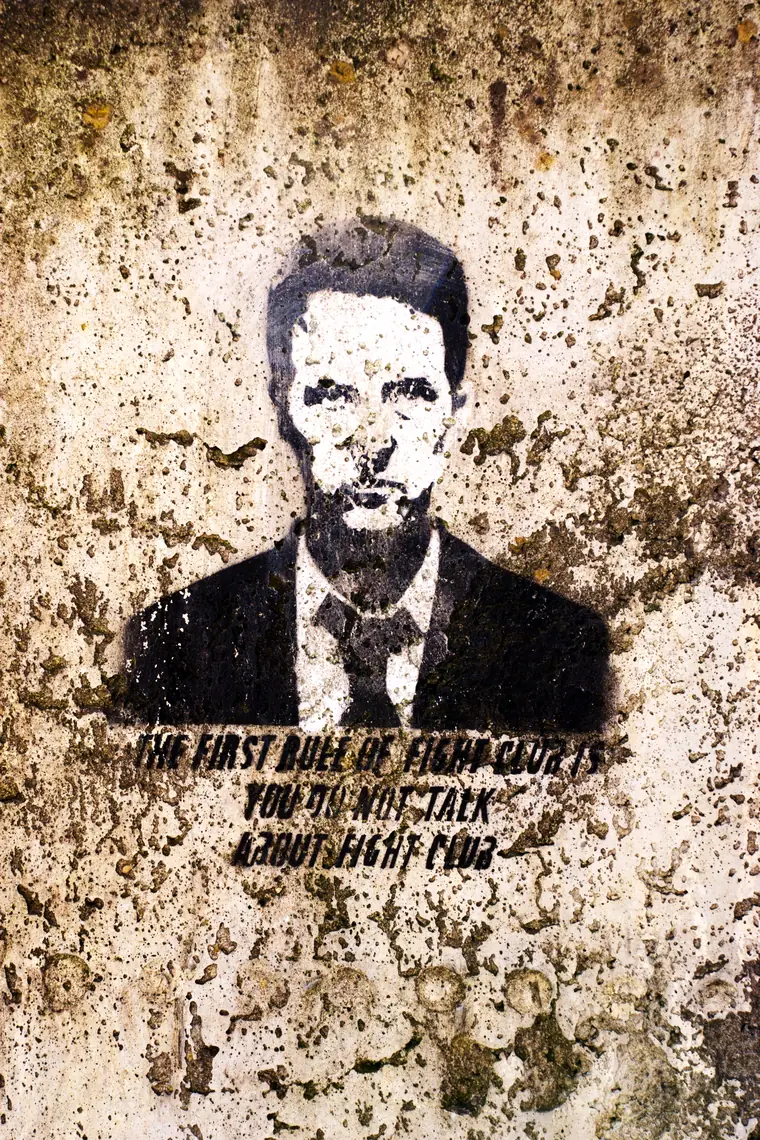
That reading explains the film's reception better than either of the first two. Fight Club was adopted as a manifesto by people the film is openly mocking, which is not a misreading so much as the exact outcome the ending predicts. Tyler's ideas are designed to survive Tyler. The film says this in its last thirty seconds and then stops talking.
What Is the Single Frame Hidden in the Final Shot?
Earlier in the film, Tyler explains his side job. He works nights as a projectionist, and he uses the booth to splice pornography into family films for one frame at a time. The Narrator describes it directly: when the cat and the dog meet for the first time in reel three, that is when you catch a flash of Tyler's contribution. Nobody knows they saw it, but they did. Tyler's comment on the technique is three words long and crude, and the film does not soften it.
The technique is not invented for the film. Ingmar Bergman spliced a random image of an erect penis into a projected film in Persona in 1966, and Fight Club is quoting it. That matters for reading the ending, because it establishes the splice as a known cinematic gesture rather than a prank. Then the film does the same thing to itself. Frame-by-frame viewers have long documented a single pornographic frame cut into the final reel, just before the cut to black, over the collapsing towers and the Pixies.
If that frame is there, it changes the ending from ambiguous to pointed. The Narrator has killed Tyler, and the last image the projector throws is Tyler's signature, executed by the director in exactly the way Tyler described. The film signs off with the trick it spent two hours teaching you to look for. On the DVD commentary, Edward Norton watches the projection-booth splice and says simply that Fincher appears in all his films. The joke is the same one at both ends of the movie, and the audience is the family film.
Why Does Tyler Appear Before We Ever Meet Him?
Tyler shows up four times before the aeroplane scene where the Narrator finally speaks to him, and each appearance lasts one frame. One frame is roughly one twenty-fourth of a second, which is slow enough for the eye to register something and too fast to identify it. The four flashes arrive at moments of stress. The first is at the photocopier, where the Narrator is trying to stay awake at work. The second is while a doctor tells him that real pain is at the testicular cancer support group. The third is behind the support group leader as he opens the meeting. The fourth is as the Narrator watches Marla walk down an alley.
Fincher called these "subliminal Brads" on the commentary track, and his stated reasoning is more useful than any fan theory. The Narrator has already created Tyler, he says, but is hesitating to release him. The flashes are Tyler's impatience. He is a solution sitting unused, surfacing at exactly the moments when the Narrator needs one and refuses to act.
"Our hero is creating Tyler Durden in his own mind, so at this point he exists only on the periphery of the Narrator's consciousness."
— David Fincher, on the Fight Club DVD commentary
That reading also explains the two appearances that are not single frames. Tyler is the furthest waiter on the right in the hotel welcome video, and a passer-by on an airport walkway. Those are not glitches. They are the Narrator's mind casting the role, and they are the only honest evidence the film gives you about how Tyler was built.
The effect is that the audience is placed inside the same condition as the character. You see something you cannot identify, four times, and then the film explains it an hour later. On a second viewing those four frames are the only honest evidence the film ever gives you, and they were always there. That is a more generous version of the trick than most films attempt, because it prints the rules of its own deception and then dares you to check them.
What Changes Between the Novel's Ending and the Film's?
Palahniuk published Fight Club in 1996. His novel and Fincher's film share a plot, a structure and most of their dialogue, and they end in completely different places. The novel's bombs do not work. Tyler's improvised explosive is mixed with paraffin and simply fails to detonate. The Narrator shoots himself anyway, and wakes up in a psychiatric hospital that he describes, in the book's final chapter, as Heaven. God is his psychiatrist. The orderlies are angels. Then they lean in and tell him they miss him, Mr. Durden.

| Palahniuk's novel (1996) | Fincher's film (1999) | |
|---|---|---|
| The bombs | They fail. Tyler's paraffin mix does not detonate. | They fire. The credit-card towers come down in sequence. |
| Where it ends | A psychiatric hospital the Narrator believes is Heaven. | A high-rise window overlooking the collapsing skyline. |
| Marla's arrival | She arrives before the shot, with support-group members, to try to stop him. | She arrives after, walked in by members who still answer to Tyler. |
| The staff | Orderlies are Project Mayhem, whispering "We miss you, Mr. Durden." | No equivalent. The space monkeys simply leave him on the floor. |
| Is Tyler gone? | Unresolved. Some scholars read the final chapter as narrated by Tyler. | Implied yes, then undercut by the closing frame. |
| Tone | Cyclical and ominous. The cult outlives its founder. | Romantic and unresolved. Two people hold hands. |
The novel's title in Polish is Podziemny Krąg, which translates as Underground Circle, and the change of title is a small version of a larger problem. Palahniuk has said his overseas publishers rewrote his ending for years so that the book finished the way the film finishes. The film's ending was more popular than the book's, so the book was quietly corrected to match it. That is worth keeping in mind when the same publishers later objected to a foreign film distributor doing the same thing in reverse.
Why Did Chuck Palahniuk Prefer the Censored Ending?
In January 2022, Fight Club arrived on the Chinese streaming service Tencent Video with its climax removed. The towers do not fall. Instead a title card appears and states, in full: "Through the clue provided by Tyler, the police rapidly figured out the whole plan and arrested all criminals, successfully preventing the bomb from exploding. After the trial, Tyler was sent to lunatic asylum receiving psychological treatment. He was discharged from the hospital in 2012."
The outcry was immediate and the reaction from the two authors was not what anyone expected. Palahniuk told TMZ that the censored version was closer to his book than the film was, and he was specific about why.
"The irony is that the way the Chinese have changed it is they've aligned the ending almost exactly with the ending of the book, as opposed to Fincher's ending, which was the more spectacular visual ending. So in a way, the Chinese brought the movie back to the book a little bit."
— Chuck Palahniuk, to TMZ, January 2022
In his newsletter he was less diplomatic, calling the change super wonderful and observing that everyone gets a happy ending in China. He also made the point that his books had been removed from American schools and prison libraries for years, and that the outcry only arrived once a foreign government altered a film.

Fincher agreed with the observation and did not agree with the edit. Speaking to Empire, he said it was funny to him that the people who wrote the Band-Aid ending in China must have read the book, because it adheres pretty closely. Then he explained the contractual failure underneath it. A company licensed the film from New Regency with boilerplate language permitting cuts for censorship, and nobody had asked whether changing the ending counted as a trim. His summary of the whole affair was that if you do not like this story, you should not license the movie, and that the film was over twenty years old and had never had a reputation for being cuddly. Tencent restored eleven of the twelve minutes two weeks later. The explosion sequence is back.
Is Marla Singer Real, or Another Projection?
There is a persistent theory that Marla is a second figment, and that the Narrator invented her the same way he invented Tyler. It deserves a straight answer, because it fails on the film's own evidence. The theory rests on the fact that Marla and Tyler are never on screen together in a way that proves both are present, and on the fact that Marla appears at the support groups, which is where the Narrator goes when he is most dissociated.
The counter-evidence is stronger. Marla interacts with other characters throughout the film. She attends the support groups and the group members react to her, which is what drives the Narrator to confront her in the first place. She has an apartment, a phone, and a medical history that other people describe. In the ending, Project Mayhem members physically walk her into the building and she holds the Narrator's hand while the towers fall. Tyler has no such scenes. Every character who acknowledges Tyler turns out to be acknowledging the Narrator. Nobody mistakes Marla for anyone else.
The theory survives anyway, and the reason is structural rather than evidentiary. The film trains you to distrust its own point of view. Once you learn that a major character was a projection, the instinct is to look for the next one, and Marla is the obvious candidate because she is the other person the Narrator cannot explain. Palahniuk resolved this himself in Fight Club 2, the 2015 comic sequel illustrated by Cameron Stewart. Marla is real, married to the Narrator, and bored. The sequel also gives him a name at last: Sebastian, which is presented as a name he chose rather than the one he was born with.
Why Did Critics Call the Ending a Cheat in 1999?
The film premiered at the 56th Venice International Film Festival on 10 September 1999, and it was released in the United States on 15 October. The critical reaction was not a mixed response so much as two separate responses that never met. The Cineaste editor Gary Crowdus summarised it later: many critics praised it as one of the most exciting and original films of the year, while the film's attackers were far more vocal. Alexander Walker of the London Evening Standard ran his review under the headline "A Nazi piece of work."
The most useful objection came from Roger Ebert, who gave it two stars out of four. He called it visceral and hard-edged, described it as a thrill ride masquerading as philosophy, and dismissed the third act as trickery. He never fully changed his mind, though he later conceded the film was beloved by most, not by him, and after watching it repeatedly for a panel he said he admired its skill even more and its thought even less. Leonard Maltin was blunter, and he attacked the ending specifically rather than the film around it.
"'The Sixth Sense's' ending so intrigues you that you're curious to see it again to work out how the pieces fit together. But 'Fight Club's' ending makes no sense — it doesn't inspire you to see it again and it made me sorry I'd sat through it the first time."
— Leonard Maltin, quoted in the New York Post, October 1999
That is the strongest case against the ending, and it deserves to be taken seriously rather than waved off. A twist that rewards a rewatch and a twist that refuses to are different kinds of ending, and Maltin is describing the second while expecting the first. Whether that is a flaw depends entirely on which kind of film you thought you were watching.
Maltin's objection has not aged well, and the reason is that the two films are doing different jobs. A rewatch of Fight Club resolves nothing, because there is nothing left to resolve. It just makes the four subliminal frames and the closing splice visible, which is the film telling you that you were watching the wrong layer the whole time. The British Board of Film Classification understood this better than most of the critics. It removed two scenes, then rejected the claim that the film was dangerous, writing that it was quite clearly critical and sharply parodic of the amateur fascism it portrays.
What Does "You Met Me at a Very Strange Time in My Life" Mean?
The Narrator's final line is delivered without irony and without apology. Marla has just found him bleeding at a window while the financial district collapses, and instead of explaining, apologising or promising anything, he offers her a formality. It is closer to the phrasing of a first date than the ending of an anarchist romance, and the mismatch is the point. The line is an understatement doing the work of a confession, which is the same move the film makes structurally.
What it does not do is answer anything. It does not say the marriage will work. It does not say Tyler is gone. It does not say the towers were worth it. It says only that the Narrator knows he is difficult to have met, which is the first honest sentence he has spoken about himself in the entire film. The Pixies come in almost immediately, and the song choice completes the joke. Where Is My Mind? was written by Black Francis in 1988 after a scuba diving trip in the Caribbean, about a small fish that followed him underwater. It has nothing to do with consumerism, and the film made it the sound of a man losing his mind anyway.
That is the ending in miniature. A song about a fish became an anthem about collapse. A line about bad timing became the last word on a character who never had a name. The film ends with two people holding hands in front of a disaster that one of them caused and both of them accept, and it refuses to say whether that is a happy ending, because it genuinely does not know.
Frequently Asked Questions
Is Tyler Durden dead at the end of Fight Club?
Yes, as a personality. The Narrator shoots himself through the cheek, which destroys Tyler without killing the body, and Tyler's body is shown collapsing with an exit wound. Whether Tyler is permanently gone is a different question, and the closing frame is widely read as undercutting the answer.
Does the Narrator die at the end of Fight Club?
No. He survives with a hole through his cheek and is carried out by Project Mayhem members. The novel keeps him alive too, but places him in a psychiatric hospital he mistakes for Heaven, which the film does not do.
Why does Tyler Durden appear in single frames before we meet him?
Fincher called them "subliminal Brads." His explanation is that the Narrator has already created Tyler but is hesitating to release him, so Tyler surfaces for one frame at moments of stress. There are four such flashes, plus two ordinary cameos.
Is there a hidden frame at the end of Fight Club?
Frame-by-frame viewers have long documented a single pornographic frame cut into the final reel, just before the cut to black. It repeats the trick Tyler describes using as a projectionist, and it is the same gesture Bergman used in Persona in 1966.
Does the novel end the same way as the film?
No. In Palahniuk's novel the bombs fail, and the Narrator wakes in a mental hospital he believes is Heaven, where the staff are Project Mayhem members who tell him they miss him, Mr. Durden. Palahniuk has said the censored Chinese ending was closer to his book than Fincher's film was.
What is the Narrator's real name?
He is never named. He is credited as The Narrator. Fans call him Jack because of the "I am Jack's..." lines, which he borrows from old magazine articles written from the point of view of body organs. Palahniuk's novel used the name Joe for those articles; the film changed it to Jack.
Is Marla Singer a figment of the Narrator's imagination?
No. Marla interacts with other characters, has her own home and medical history, and is physically walked into the final scene by Project Mayhem members. Palahniuk's 2015 comic sequel Fight Club 2 confirms she is real and married to the Narrator.
What does "Where Is My Mind?" have to do with the ending?
Nothing originally. Black Francis wrote it in 1988 about a fish that followed him while scuba diving. Fincher placed it over the final sequence, and the film permanently attached the song to the image of a man losing his mind.
Sources
- Fight Club (1999), dir. David Fincher. 20th Century Fox / Fox 2000 Pictures / Regency Enterprises / Linson Films. 139 minutes. Based on the 1996 novel by Chuck Palahniuk, screenplay by Jim Uhls.
- Box office: Box Office Mojo and The Numbers — $63,000,000 budget; $37,030,102 domestic; $63,823,651 international; $100,853,753 worldwide; $11,035,485 opening weekend from 1,963 theatres.
- Rotten Tomatoes: 81% from 251 reviews, 7.80 average, Certified Fresh; audience score 96% from 73,866 ratings. Metacritic: 67 from 36 critics.
- CinemaScore: B−. Audience composition at release: 61% male, 39% female, 58% under 21.
- David Fincher, DVD commentary track — on the four "subliminal Brads" and the reasoning behind them.
- Chuck Palahniuk, interview with TMZ, 26 January 2022 — on the Chinese ending and the novel's original finale.
- David Fincher, interview with Empire, 14 February 2022 — on the "Band-Aid" ending, the licensing contract, and why the change makes no sense to him.
- Chinese release title card, Tencent Video, 2022, quoted in full; restoration of 11 of the 12 cut minutes reported by The Hollywood Reporter and IndieWire.
- British Board of Film Classification, 1999 — 18 certificate, two scenes removed, and the board's written verdict that the film is critical and parodic of the fascism it portrays.
- Roger Ebert, Chicago Sun-Times, 1999 — two stars out of four; later remarks at the Conference on World Affairs. Leonard Maltin, quoted in the New York Post, October 1999.
- Gary Crowdus, Cineaste — retrospective summary of the 1999 critical reception.
- The New York Times, 2009 — tenth-anniversary piece calling Fight Club the defining cult movie of our time.
- Chuck Palahniuk and Cameron Stewart, Fight Club 2, Dark Horse Comics, 2015 — the sequel that names the Narrator Sebastian.
- Pixies, "Where Is My Mind?", Surfer Rosa, 4AD, released 21 March 1988; written by Black Francis, produced by Steve Albini.
- Fight Club 4K Ultra HD, 20th Century Studios, 2026 — new master approved by Fincher from the original 35mm camera negative; HDR10, DTS-HD Master Audio 5.1, 100GB disc.

Open Ending Editorial
Film analysis desk
We write about films that refuse to answer their own questions. Every claim is sourced to a primary interview, a box-office record, or a review aggregate — and where a source does not exist, we say so instead of guessing.